San Diego Winter Confrence

Josh and I will be at the San Diego winter confrence all week with 800 something students from the pacific southwest, including 10-12 students from SF State. Please be praying that the Lord would work powerfully this week and create a major "shift" (our theme this year) in their lives and perspective because of their interactions with Christ.

Also, if you want to watch the main sessions live (featuring amazing speakers) go to http://www.facebook.com/sdwinterconf


Read more

The Story of Silent Night

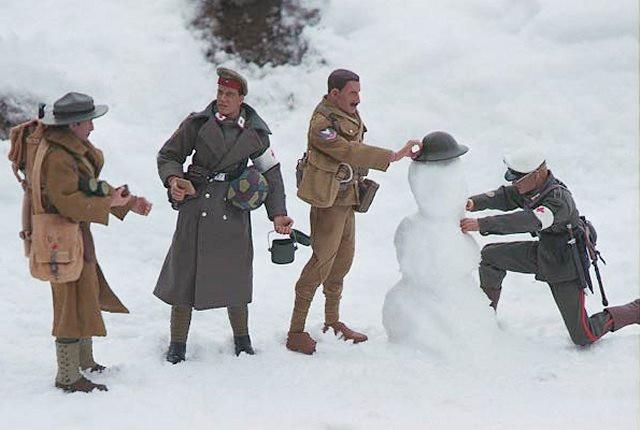
The story of the hymn Silent Night was on the radio today and it made me cry, both tears of joy and anger. During WWI, in 1914 on Christmas Day, a temporary truce was called on the battlefields between the German and British armies and enemy soldiers came together to give gifts and care for the dead who previously were in limbo in No Man’s Land between the trenches. As they came together they sang the only Christmas song both sides knew, Silent Night, a hymn written nearly 100 years before in Austria where it was unknown for years except for the small town in the Alps where it was written until a visiting organ maker got a hold of the sheet music and gave it to a traveling family minstrel group (think the Von Trap family in The Sound of Music) who began to sing the song as they traveled Europe. Eventually the song grew in popularity was translated from German to English and today remains one of the most beloved of all Christmas hymns.


So why the tears this morning? As I drove and listened to a particularly quiet, haunting version sung by Sinead O’Connor, I thought of what a beautiful picture of Christ entering the world the story of the Christmas day truce and the soldiers singing together is. In the midst of war, death, horror, untold pain, courage, cowardice, mud, grime, filth, no man’s land and trenches, there was a moment of peace, where Christ was exalted by soldiers who had no reason to worship and sing other than being alive. This moment of clarity in the midst of such evil, death and darkness is a wonderful picture of what the birth of Jesus was and is to a world ravaged by sin and death. The joy of the birth of Christ of course, is that he grew up and went on to live the life we never could and defeated death and evil on the cross; the birth is the decisive moment of God entering into the world, putting his plan in motion. A plan that involved God himself suffering, experiencing a fallen world, God himself having people die for His sake (the young boys murdered by Herod after the rumor of the coming King reached him) before He died for all creation’s. It would be akin to the generals who were leading the insanity of WWI entering into those trenches, seeing No Man’s Land and experiencing the suffering and death there. Of course those generals were the problem not the solution but you get the point. The joy of the birth of Jesus is that He is Emmanuel, God with us in the midst of it all.
What angered me to tears when I heard the story this morning was the tragedy that after they sang together and exchanged gifts, after Christmas was over, the war continued, death marched on and hundreds of thousands more were lost due to the evil, prideful, nationalistic, sinful stubbornness of a few men sitting comfortably in their chateaus and castles. The same awful men who condemned the Christmas Truce treasonous. Of course I am simplifying things a bit but even the complicated truth is just as insane and stupid. What angers me is why evil like that exists in a world where I believe, sin and death are already defeated, the outcome is final but the game is still going on so to speak. I wish I understood, I wish I had an answer but I don’t and I come to a fork in the road, a decision I have to make: either I reject Jesus and choose to believe such evil is a part of human life that will never change or be defeated or I surrender my ignorance and frustration to Jesus and choose to follow Him with all I am and hold on to the hope He promised, that one day He will rid the world finally and decisively of all the ravages of sin and heal a fallen creation. For me the character of Jesus wins out, the evidence of his astounding faithfulness in my life, the moments I have seen his restorative healing love trump evil cause me to trust in him, like a child trusts his father when He says one day the hope promised will come to be final. It doesn’t change the anger that wells up when injustice is allowed to triumph over justice but it causes me to trust God’s ultimate justice is coming, in His timing, to rid the world of evil and that He is God with us now, in the midst. That is the hope of Christmas, the joy of Jesus, the future hope promised to us.
*As a small footnote, such faith and trust in God’s ultimate justice shouldn’t lead to an escapist (and in my opinion very American evangelical) mentality of screw the world lets just focus on heaven. The whole point of such a future hope is that we would reflect Jesus in the here and now and allow the Holy Spirit to work through us to bring the future into the presence, to bring the hope, message, and active love of Jesus into the world around us. I realize I am just repeating a theme I often repeat on this blog but when I see on TV that you can buy an American flag colored Christmas tree with a freaking CROSS in the middle of it I get kind of depressed and feel the need to reiterate it.
Read more

Zechariah in the Christmas Story


This past weekend I had the pleasure of seeing The King’s Speech, a movie about King George the 6th of England and the relationship he had with his speech therapist. The movie is incredible, and if Colin Firth and Geoffrey Rush don’t win Oscars for their respective performances I am no judge of good acting (which I am not, I am a missionary not an actor). Anyway, the movie tells the story of King George’s battle with a lifelong stutter and how he eventually finds his voice at the time when his country needs a pillar of strength and courage to look to as they plunged headlong into war with Hitler’s Germany.

So what does this have to do with Christmas? Well the story of Bertie, as King George is called in the film, reminded me somewhat of Zechariah’s story in the Gospel of Luke and it got me thinking of that often lost portion of the Advent.

The story of Zechariah is a story of helplessness. To be helpless is a fault in our world, a characteristic reserved for children. In fact, the entirety of our modern education system is really devoted to unmaking our helplessness and furthering our independence as individuals. To experience true, humbling helplessness can be somewhat of a shock. And yet the Bible is very clear in its insistence that we are indeed in desperate need of help from our God who loves us.

Nowhere is this more poignantly realized than in Luke’s Christmas story. From Mary to Joseph to Zechariah to Elizabeth to the infant Jesus himself, each character in one form or another displays a wonderful lack of control and a desperate dependence on the Lord and his faithfulness. For Zechariah, the father of John the Baptist, the story begins with a visit from Gabriel, the arch-angel. Zechariah is a priest who loved God and obeyed his commandments blamelessly, and yet his life has already been marked by the helplessness of being unable to become a father. How humbling and heartbreaking an experience it must be for a husband and wife who want to make the transition to loving father and mother but are unable to. As Zechariah and Elizabeth’s age increased so did the murmurs of their family, neighbors, town and society. Zechariah was a man with no heir, no child to carry on his legacy and family. How hard it must have been on his faith that the God who the Psalms promise “will give you the desires of your heart” had not and had left him and his wife barren. It is a testament to Zechariah’s faith that he continued to dutifully love and obey God in spite of this.
So imagine his audacity when he is visited by Gabriel who, speaking on behalf of God, promises a child. Imagine the pain that reestablished itself in Zechariah’s heart, the wounds which were reopened as he heard this promise and simultaneously recalled moment after moment of bitter disappointment, of dashed hopes and of angry pleas to God seemingly unheard. You can almost hear the defeat in his voice as he remembers time after time when he felt deep in his soul Elizabeth was pregnant, only to have those feelings give way to the crushing reality that she was not. “How shall I know this,” he whispers, barely audible, “I am an old man and my wife is past child bearing age.”

And Gabriel responds, “I am Gabriel, I stand in the presence of the perfect, holy and good God.” Its interesting that Gabriel, in the midst of Zechariah’s pain and doubt affirms the greatness of God, something Zechariah, a priest no less, needed to be reminded of in that moment. And then Zechariah’s mouth is shut and Gabriel tells him, you will see the goodness of God, the wonderful plan he has laid out for you all along. Watch only and do not protest as the Lord takes one of the darkest, most painful corners of your existence and turns it into joy and gladness. “Many will rejoice,” Gabriel says, “your community will look at Elizabeth, see your son, and be themselves reminded of the wonder and glory of God.” And Zechariah is left silent, helplessly awaiting the fulfillment of a promised hope again. How constantly he must have wondered in his silence, if God would really come through this time. His helplessness before the Lord would have increased each day as his hope and fear grew. As Elizabeth began to show, his heart would have leapt, ‘could this really be?’

But in all the days leading up to the birth of his son, never did he experience the depth and completeness of his utter dependence on God like the day his son was born. As he saw his son for the first time, as he held him close how Zechariah’s heart must have pounded and how helpless he must have felt before the glory of God, his awe complete, his dependence pure, his faith void of doubt, his pride destroyed, his fears vanquished, his hopes fully realized, he stood before his God completely and utterly helpless and did the only thing one could do in the moment; he found his voice again and praised the King of Kings.
Read more

Some Thank Yous


Thank you for today, and if it come tomorrow
Thanks for the cold air that makes its home in Autumn
Thanks be to God who makes mornings like this happen
Thanks to rain swept days when all weather rules slacken

Thank you Christ who in love can laugh at my expense
Thanks Alex for making my scattered thoughts make sense
Thank you Paul and Kevin, friends who never stale
Thanks Mom and Dad who always answer, never fail

Thank you orange leaves who teach all springtimes must end
Thank you for your patience Lord when I am a wretch
Thank you there is stuffing for those who hate turkey
Thanks for days of gratitude, we need more dearly

Thank you for the rocky paths that lead to redemption
Thank you that You love us without condescention
Thanks to my wife who proves life isn't always fair,
'Cause I don't deserve a love so sweet but she is always there

Read more

Reflections on Psalm 23 & 24 Part 2

This is the second post of a two part reflection on Psalm 23 & 24, which I (Josh) have been reading over the past couple of weeks.

Psalm 24
A Psalm of David.
1 The earth is the LORD’s and the fullness thereof,
the world and those who dwell therein,
2for he has founded it upon the seas
and established it upon the rivers.

3 Who shall ascend the hill of the LORD?
And who shall stand in his holy place?
4 He who has clean hands and a pure heart,
who does not lift up his soul to what is false
and does not swear deceitfully.
5He will receive blessing from the LORD
and righteousness from the God of his salvation.
6Such is the generation of those who seek him,
who seek the face of the God of Jacob.
Selah

7 Lift up your heads, O gates!
And be lifted up, O ancient doors,
that the King of glory may come in.
8Who is this King of glory?
The LORD, strong and mighty,
the LORD, mighty in battle!
9Lift up your heads, O gates!
And lift them up, O ancient doors,
that the King of glory may come in.
10Who is this King of glory?
The LORD of hosts,
he is the King of glory!
Selah


In Psalm 24 following directly after Psalm 23, David widens his scope and focuses on the Kingship of God. A king himself, David realizes and acknowledges that God’s kingdom contains the whole earth “and the fullness thereof”. God is the King of Glory, the royal savior who has founded and established the very earth. What I noticed as I read this psalm directly after psalm 23 is the different type of hope it presents. Psalm 23’s hope is the promised intimacy of a loving nurturing God who is Shepherd, who walks with us, makes us lie down in green pastures, who leads us to refreshing streams, who serves us and allows us to dwell in his presence forever. Psalm 24 takes a different tone. The King of Glory, David’s King and ours, is first and foremost holy. He sits on his hill and David asks the question, “who shall ascent” to his place to be near him, while in Psalm 23 David sings he will “dwell in the house of the Lord forever”. The King of Glory demands holiness, clean hands and a pure heart from those who worship him. In Psalm 23, God is the Shepherd alongside us but in Psalm 24, we have to “seek him”.

I realize this sounds like David is presenting two very different Gods but I don’t think he is. Rather than contrasting the two Psalms compliment each other. The King of Glory comes to bring justice and victory over evil, he is strong and mighty and none can stand against him. The Shepherd is with us in the very shadow of evil and death. The King of Glory demands holiness, a completely pure heart; the Shepherd leads us to paths of righteousness, helping us by his steady hand and presence to become holy.

The hope of Psalm 24 is that God, the King will come and defeat evil in the world, bringing his justice and glory. It is the hope that the enemies of Psalm 23 will be destroyed, the valley of the shadow of death will be restored and safe once more and there will be no more evil to fear. What I love about David is his understanding that both aspects of God’s nature are needed in order to have a full understanding of Him. Without a Psalm 23 understanding of the God who loves us, who leads us intimately, who walks with us and overflows with mercy and goodness, we are left with the King of Glory alone, the King who you see from afar on his holy hill, whose power is terrible and absolute and while you want him to be victorious and rid the world of all evil, you aren’t comfortable calling him friend or speaking to him. The King demands holiness and the reality is we as humans are incapable of producing such holiness. We must have the Shepherd guiding us to paths of righteousness, walking alongside us, inviting us into his presence.

But without a Psalm 24 understanding of God, we are left with the Shepherd alone, who is good and loving and merciful but not necessarily someone you would say is all powerful. He protects us and is with us through evil, comforting, but comforting us is not the same as coming in power to definitively destroy all evil. We need the King of Glory to shape our hope for the future, the hope of evil defeated and the world restored.

The beauty of these Psalms is that they point to Jesus who is the Shepherd and the King of Glory in one, the God who loves us so infinitely and intimately he became one of us and who defeated sin and death by his death and resurrection. Rather than be unsure of how close we want to be to the King of Glory, God’s intimate love manifest through Christ assures us we can come close and dwell in his presence. Rather than being unsure of just how powerful the Shepherd is when it comes to evil and death, the Cross tells us evil is already defeated, waging a losing war and one day Jesus will come in glory and power to rid the world completely and finally of both. Jesus came to live with us, to Shepherd us into the very presence of himself than defeated evil on the cross. In Jesus the Shepherd and the King of Glory come together in perfect harmony.

Read more

Reflections on Psalm 23 & 24 Part 1

This is the first post of a two part reflection on Psalm 23 & 24, which I (Josh) have been reading over the past couple of weeks. The second half on Psalm 24 and bringing the two together will be up later this week.

A Psalm of David.
1The LORD is my shepherd; I shall not want.
2He makes me lie down in green pastures.
He leads me beside still waters.
3He restores my soul.
He leads me in paths of righteousness
for his name’s sake.

4Even though I walk through the valley of the shadow of death,

I will fear no evil,

for you are with me;

your rod and your staff,

they comfort me.

5You prepare a table before me

in the presence of my enemies;

you anoint my head with oil;

my cup overflows.

6Surely goodness and mercy shall follow me

all the days of my life,

and I shall dwell in the house of the LORD

forever.

Lately I have been reading over Psalm 23 and 24, noticing the contrast between the two adjacent poems. It is a contrast which adds depth to what each is saying about God. On the one hand you have Psalm 23, one of the most beloved and beautiful passages in the entire Bible. The Psalm is almost tangibly full of the gentle peace of a life lived in the presence of God, a God who nurtures, cares for, protects and provides for us. One can almost picture David composing it, perhaps walking as king among the very landscape where as a young shepherd boy he first fell in love with the Lord. With each line David discovers the depth and unquenchable love of God for him. Each familiar stream, pasture and path reveals clues to the good and merciful God who chose David to be King over Israel. This is a David young and fresh from the pressures of being a King, the triumphs and horrors of war, the overwhelming responsibilities of bureaucratic life and the constant needs of his people. So David, as we all need to do from time to time, takes a personal vacation back to his home, his shepherd childhood where he was free to wander the countryside and soak in the majesty of God, the God who was and is his Shepherd.

Psalm 23 reveals a motherly aspect of God’s love. It has a quiet, almost maternal tone; like a mother, God protects and comforts, nurtures and provides for David, the psalm is similar in tone to Psalm 91 where God desires to bring David ‘under his wings’ as a hen would her chicks. The love of God for David and for us is eternal, never wavering, the fullness of what a mother’s love for her child in this world points too.

The Psalm also finds David connecting his past as a shepherd with the realization that God is the ultimate Shepherd. God leads to green pastures, to quiet streams, is a source of comfort through dangerous valleys and provides food and drink for those He guides. He knows his flock intimately and totally and seeks us when we are lost, something Jesus reminds us in Luke 15:1-7.

It is no wonder Psalm 23 has become one of the most cherished passages in all Scripture, for it taps into the basic human desire to be loved, cared for, protected and sheltered. As I read the Psalm, I become acutely aware that I am God’s child or lamb, that he is my caretaker, my nurturer, the source of my very life. He is the perfect shepherd, the perfect mother, the perfect source of unfaltering love. W.H. Auden once wrote:

Nothing can be loved too much,

But all things can be loved

In the wrong way.

Psalm 23 reminds us, or in some cases informs us for the first time, that God will never love us the wrong way, his love will always be perfect and we can never have too much of it.

Read more

From the Future: An Entirely Misleading Title


The older I get (24 is ancient), the longer I have walked with Jesus, the more I realize the Christian walk is a constant cycle of learning and unlearning. The Holy Spirit and the Bible are there to challenge us, to point out truth and untruth in our lives and too constantly change the way we interact in the world to be more like Jesus. A year ago, the things I was thinking about on a daily basis were different then they are today. Partially because I have settled on truth I believe the Holy Spirit led me too, and partially, if I am honest, because I lost interest in the ‘issues’ so important to me back then.

The past 3 months I have been trying to find the balance between being informed and knowledgeable about current issues pertaining to my faith and the world and simply enjoying the presence of Jesus in my world, community and life. I have written about this already. What I was thinking about this morning however, is how easy it is for young Christians to hold fast to certain ideas/opinions/things, thinking their minds will never change when it comes to those issues they feel so passionately about. Not to knock passion, we need it in our lives and Jesus demands passion for him. No, I’m speaking more about what I’ve struggled with and continue to struggle with daily when it comes to living in a world of constant input that demands opinions from everyone about everything. Secondary issues are easily elevated to foundational truths with a depressing and destructive effect on one’s walk with Jesus. Instead of His glory we see our own as we engage in imaginary intellectual debate and dream of comprehensively crushing our opponent and impressing everyone listening (admit it, we’ve all dreamt of it). This pride worms its way into our walk with God so even our times in the Word or in prayer are consumed by it. Then two weeks later we realize our hearts are dry and the God we thought we were honoring with our constant mental soap-boxing has actually been waiting for us to shut up and enjoy his life-giving presence, instead of making it all about our own intellectual fortitude.

I guess all that to say is IF I could go back in time and tell myself then (a year or two ago) what I know now, I would say “Relax. Focus on Jesus before any of the crap besides him you are so passionate about. Misplaced passion is one of the great tragedies of the Christian life. Remember why you love Jesus, all he has done for you, and realize the Christian life is a journey of constant learning and unlearning. Trust me, I’m from the future.”

Read more